Monday, September 13, 2010

Investment Contributions 2Q 2010


For the following graph, red is residential, green is equipment and software, and blue is investment in non-residential structures. The usual pattern - both into and out of recessions is - red, green, blue...

The key leading sector - residential investment - has lagged the recovery because of the huge overhang of existing inventory. Usually RI is a strong contributor to GDP growth and employment in the early stages of a recovery, but not this time - and this is a key reason why the recovery has been sluggish so far.

source

Mismanaging the Economy

Jacob Hornberger writes:

What’s the real solution to America’s economic woes?

It lies in asking ourselves a fundamental question: Should the role of government in a free society be to manage an economy?

The answer is: No, absolutely not. The government has no more business managing an economy than it does managing people’s religious activities.

After all, what is an economy? It’s really just people sustaining and improving their lives and interacting with others in economic matters. It’s an intricate and complex process that involves countless people producing goods and services and exchanging them with others.

So, when the president purports to manage the economy, what he’s really doing is attempting to manage, control, direct, or influence the economic decisions of hundreds of millions of people, each of whom is trying to plan and direct his own affairs. In other words, one man — or group of people in the federal government — purports to plan, in a top-down, command-and-control manner, the economic decisions of countless people, a phenomenon that the Nobel Prize winning libertarian economist Friedrich Hayek called a “fatal conceit.“ It cannot be done, and in fact all that it produces is crisis and chaos.

The problem Americans face is not that President Obama is mismanaging the economy. The problem is a systemic one, one that delegates to the president the authority to manage the economy.

The solution to America’s economic woes lies not in getting better people in public office who can better manage the economy. The solution lies in prohibiting government officials from managing the economy. Managing the economy is not a legitimate function of government in a free society, and in fact is the root cause of a nation’s economic woes.

The French have a term for this: “Laissez faire, laissez passer.“ Let it be, let it pass. Leave people free to manage their own economic affairs. Separate economy and the state in the same way that our American ancestors separated church and state.

source

Richard Daughty on Alan Greenspan

Daughty writes:

Instantly, at the mention of the name of the loathsome Alan Greenspan, chairman of the Federal Reserve from 1987 to 2006, people reflexively grow alarmed that I am going to Go Freaking Berserk (GFB) about how much I despise that little piece of lowlife intellectual poseur crap who single-handedly created so much money, committed so much intellectual fraud, like creating the infamous Hedonic Adjustment of inflation statistics, and who has caused all the economic problems of crushing debt that bedevil us, that he belongs in a filthy, rat-infested prison where he never sees the sun as a “best case” scenario for him, the little bastard.

source

Keynesianism Refuted

We have recently stumbled on the phrase "military Keynesianism," and more and more we wonder if this is not an apt description of the system that the Anglo-American axis has put into place. We found a definition of military Keynesianism at Wikipedia as follows:

Military Keynesianism is a government economic policy in which the government devotes large amounts of spending to the military in an effort to increase economic growth. This is a specific variation on Keynesian economics, developed by English economist John Maynard Keynes...

The economic effects advanced by supporters of military Keynesianism can be broken down into four areas, two on the demand side and two on the supply side. On the demand side, increased military demand for goods and services is generated directly by government spending. Secondly, this direct spending induces a multiplier effect of general consumer spending. These two effects are directly in line with general Keynesian economic doctrine.

On the supply side, the maintenance of a standing army removes many workers, from the civilian workforce. In the United States, enlistment is touted as offering direct opportunities for education or skill acquisition. Also on the supply side, it is often argued that military spending on research and development (R&D) increases the productivity of the civilian sector by generating new infrastructure and advanced technology.

Of course all this is nonsense. It is part of the well-known "broken-window fallacy" and therefore partakes of the dubious assumption that one can create prosperity by destroying things and then rebuilding them. In fact, there is certainly logic to the idea that destruction creates prosperity if one simply looks at World War II from the American point of view. But a ruined Europe surely paid the price for America's resurgence.

Keynesianism is truly a disease of the West, an economic theory that does not die. Simplified to its most basic components, it uses force to grant government (and the shadowy, mercantilist elite behind it) the power to print money via central banks. Central banks then overprint money causing endless economic misalignments that result in booms and busts. Having impoverished society, those in charge of the printing presses are tempted to "stimulate" the domestic economy (and their own bank accounts) by creating war.

Conclusion: Always, Keynesianism is destructive. It spreads poverty at home and violence abroad. It centralizes power wherever it is practiced, so that the banking establishment and the military complex are inexorably pressed together until they are virtually one unit. Eventually, a large portion of a nation's creativity and creation may be co-opted by military production and subsequent sales. This is the political system that the West has exported to Iraq and is in the process of attempting to spread to Afghanistan. We prefer free markets.

source

Cartoon: Book Burning

Saturday, September 11, 2010

Cartoon: Book Burning

Cartoon: Double Dip Recession

Cartoon: If I Had a Hammer

How to" Fix" a Recession

What does Mises say should be done, say by government, once the depression arrives?

What is the governmental role in the cure of depression? In the first place, government must cease inflating as soon as possible. It is true that this will, inevitably, bring the inflationary boom abruptly to an end, and commence the inevitable recession or depression. But the longer the government waits for this, the worse the necessary readjustments will have to be. The sooner the depression-readjustment is gotten over with, the better. This means, also, that the government must never try to prop up unsound business situations; it must never bail out or lend money to business firms in trouble. Doing this will simply prolong the agony and convert a sharp and quick depression phase into a lingering and chronic disease.

The government must never try to prop up wage rates or prices of producers' goods; doing so will prolong and delay indefinitely the completion of the depression-adjustment process; it will cause indefinite and prolonged depression and mass unemployment in the vital capital goods industries.

The government must not try to inflate again, in order to get out of the depression. For even if this reinflation succeeds, it will only sow greater trouble later on.

The government must do nothing to encourage consumption, and it must not increase its own expenditures, for this will further increase the social consumption/investment ratio. In fact, cutting the government budget will improve the ratio.

What the economy needs is not more consumption spending but more saving, in order to validate some of the excessive investments of the boom. Thus, what the government should do, according to the Misesian analysis of the depression, is absolutely nothing. It should, from the point of view of economic health and ending the depression as quickly as possible, maintain a strict hands off, "laissez-faire" policy. Anything it does will delay and obstruct the adjustment process of the market; the less it does, the more rapidly will the market adjustment process do its work, and sound economic recovery ensue.

The Misesian prescription is thus the exact opposite of the Keynesian: It is for the government to keep absolute hands off the economy and to confine itself to stopping its own inflation and to cutting its own budget.

source

Economic Depressions: Their Causes and Cure

Murray Rothbard writes:

What, then, are the causes of periodic depressions? Must we always remain agnostic about the causes of booms and busts? Is it really true that business cycles are rooted deep within the free-market economy, and that therefore some form of government planning is needed if we wish to keep the economy within some kind of stable bounds? Do booms and then busts just simply happen, or does one phase of the cycle flow logically from the other?

The currently fashionable attitude toward the business cycle stems, actually, from Karl Marx...
Marx concluded that business cycles were an inherent feature of the capitalist market economy. All the various current schools of economic thought, regardless of their other differences and the different causes that they attribute to the cycle, agree on this vital point: That these business cycles originate somewhere deep within the free-market economy. The market economy is to blame. Karl Marx believed that the periodic depressions would get worse and worse, until the masses would be moved to revolt and destroy the system, while the modern economists believe that the government can successfully stabilize depressions and the cycle. But all parties agree that the fault lies deep within the market economy and that if anything can save the day, it must be some form of massive government intervention.

There are, however, some critical problems in the assumption that the market economy is the culprit. For "general economic theory" teaches us that supply and demand always tend to be in equilibrium in the market and that therefore prices of products as well as of the factors that contribute to production are always tending toward some equilibrium point. Even though changes of data, which are always taking place, prevent equilibrium from ever being reached, there is nothing in the general theory of the market system that would account for regular and recurring boom-and-bust phases of the business cycle...

In the market economy, one of the most vital functions of the businessman is to be an "entrepreneur," a man who invests in productive methods, who buys equipment and hires labor to produce something which he is not sure will reap him any return...The market economy, then, is a profit-and-loss economy, in which the acumen and ability of business entrepreneurs is gauged by the profits and losses they reap. The market economy, moreover, contains a built-in mechanism, a kind of natural selection, that ensures the survival and the flourishing of the superior forecaster and the weeding-out of the inferior ones...How is it that, periodically, in times of the onset of recessions and especially in steep depressions, the business world suddenly experiences a massive cluster of severe losses?

An explanation such as "underconsumption" — a drop in total consumer spending — is not sufficient, for one thing, because what needs to be explained is why businessmen, able to forecast all manner of previous economic changes and developments, proved themselves totally and catastrophically unable to forecast this alleged drop in consumer demand. Why this sudden failure in forecasting ability?...

In particular, a theory of depression must account for the mammoth cluster of errors which appears swiftly and suddenly at a moment of economic crisis, and lingers through the depression period until recovery...Here is another fact of business cycle life that must be explained — and obviously can't be explained by such theories of depression as the popular underconsumption doctrine: That consumers aren't spending enough on consumer goods. For if insufficient spending is the culprit, then how is it that retail sales are the last and the least to fall in any depression, and that depression really hits such industries as machine tools, capital equipment, construction, and raw materials?...

Fortunately, a correct theory of depression and of the business cycle does exist, even though it is universally neglected in present-day economics...Essentially, these theorists saw that another crucial institution had developed in the mid-eighteenth century, alongside the industrial system. This was the institution of banking, with its capacity to expand credit and the money supply (first, in the form of paper money, or bank notes, and later in the form of demand deposits, or checking accounts, that are instantly redeemable in cash at the banks). It was the operations of these commercial banks which, these economists saw, held the key to the mysterious recurrent cycles of expansion and contraction, of boom and bust, that had puzzled observers since the mid-eighteenth century.

The banks, then, happily begin to expand credit, for the more they expand credit the greater will be their profits. This results in the expansion of the money supply within a country, say England. As the supply of paper and bank money in England increases, the money incomes and expenditures of Englishmen rise, and the increased money bids up prices of English goods. The result is inflation and a boom within the country. But this inflationary boom, while it proceeds on its merry way, sows the seeds of its own demise...

As this process intensifies, the banks will eventually become frightened. For the banks, after all, are obligated to redeem their liabilities in cash, and their cash is flowing out rapidly as their liabilities pile up. Hence, the banks will eventually lose their nerve, stop their credit expansion, and in order to save themselves, contract their bank loans outstanding...The bank contraction reverses the economic picture; contraction and bust follow boom...

This, then, is the meaning of the depression phase of the business cycle. Note that it is a phase that comes out of, and inevitably comes out of, the preceding expansionary boom. It is the preceding inflation that makes the depression phase necessary. We can see, for example, that the depression is the process by which the market economy adjusts, throws off the excesses and distortions of the previous inflationary boom, and reestablishes a sound economic condition. The depression is the unpleasant but necessary reaction to the distortions and excesses of the previous boom.

Why, then, does the next cycle begin? Why do business cycles tend to be recurrent and continuous? Because when the banks have pretty well recovered, and are in a sounder condition, they are then in a confident position to proceed to their natural path of bank credit expansion, and the next boom proceeds on its way, sowing the seeds for the next inevitable bust...

Banks can only expand comfortably in unison when a Central Bank exists, essentially a governmental bank, enjoying a monopoly of government business, and a privileged position imposed by government over the entire banking system. It is only when central banking got established that the banks were able to expand for any length of time and the familiar business cycle got underway in the modern world...

So now we see, at last, that the business cycle is brought about, not by any mysterious failings of the free market economy, but quite the opposite: By systematic intervention by government in the market process. Government intervention brings about bank expansion and inflation, and, when the inflation comes to an end, the subsequent depression-adjustment comes into play...

The correct and fully developed theory of the business cycle was finally discovered and set forth by the Austrian economist Ludwig von Mises, when he was a professor at the University of Vienna...

Without bank credit expansion, supply and demand tend to be equilibrated through the free price system, and no cumulative booms or busts can then develop. But then government through its central bank stimulates bank credit expansion by expanding central bank liabilities and therefore the cash reserves of all the nation's commercial banks. The banks then proceed to expand credit and hence the nation's money supply in the form of check deposits. As the Ricardians saw, this expansion of bank money drives up the prices of goods and hence causes inflation. But, Mises showed, it does something else, and something even more sinister. Bank credit expansion, by pouring new loan funds into the business world, artificially lowers the rate of interest in the economy below its free market level.

On the free and unhampered market, the interest rate is determined purely by the "time-preferences" of all the individuals that make up the market economy...

The inflationary boom thus leads to distortions of the pricing and production system. Prices of labor and raw materials in the capital goods industries had been bid up during the boom too high to be profitable once the consumers reassert their old consumption/investment preferences. The "depression" is then seen as the necessary and healthy phase by which the market economy sloughs off and liquidates the unsound, uneconomic investments of the boom, and reestablishes those proportions between consumption and investment that are truly desired by the consumers...

What does Mises say should be done, say by government, once the depression arrives? What is the governmental role in the cure of depression? In the first place, government must cease inflating as soon as possible. It is true that this will, inevitably, bring the inflationary boom abruptly to an end, and commence the inevitable recession or depression. But the longer the government waits for this, the worse the necessary readjustments will have to be. The sooner the depression-readjustment is gotten over with, the better. This means, also, that the government must never try to prop up unsound business situations; it must never bail out or lend money to business firms in trouble. Doing this will simply prolong the agony and convert a sharp and quick depression phase into a lingering and chronic disease. The government must never try to prop up wage rates or prices of producers' goods; doing so will prolong and delay indefinitely the completion of the depression-adjustment process; it will cause indefinite and prolonged depression and mass unemployment in the vital capital goods industries. The government must not try to inflate again, in order to get out of the depression. For even if this reinflation succeeds, it will only sow greater trouble later on. The government must do nothing to encourage consumption, and it must not increase its own expenditures, for this will further increase the social consumption/investment ratio. In fact, cutting the government budget will improve the ratio. What the economy needs is not more consumption spending but more saving, in order to validate some of the excessive investments of the boom. Thus, what the government should do, according to the Misesian analysis of the depression, is absolutely nothing. It should, from the point of view of economic health and ending the depression as quickly as possible, maintain a strict hands off, "laissez-faire" policy. Anything it does will delay and obstruct the adjustment process of the market; the less it does, the more rapidly will the market adjustment process do its work, and sound economic recovery ensue.

The Misesian prescription is thus the exact opposite of the Keynesian: It is for the government to keep absolute hands off the economy and to confine itself to stopping its own inflation and to cutting its own budget.

read the entire essay

Real GDP per Capita

The National Bureau of Economic Research has documented 33 recessions since 1857, including a few major ones that are easily identifiable in the chart above: a) three severe contractions in the 1865-1880 period following the Civil War (with the third one lasting more than five years) and accompanied by a 20-year period of below-average economic growth, and b) the Great Depression with two official recessions (August 1929 to August 1933; and May 1937 to June 1938) and a ten-year period of below trend growth in output.

Despite the vagaries of the business cycle, unexpected periods of recessions, a civil war, two world wars, a Great Depression, etc., there's one thing we can always count on in the long-run: 2% real growth in per-capita GDP, meaning that that output per person in the U.S. doubles every 35 years, or about twice during the average person's lifetime.

source

It's A Depression

This is what a depression is all about — an economy that 33 months after a recession begins, with zero policy rates, a stuffed central bank sheet, and a 10% deficit-to-GDP ratio, is still in need of government help for its sustenance...

Finally, you know it’s a depression when, 33 months after the onset of recession…

• Wages & Salaries are still down 3.7% from the prior peak
• Corporate profits are still down 20% from the peak
• Real GDP is still down 1.3% from the peak
• Industrial production is still down 7.2% from the peak
• Employment is still down 5.5% from the peak
• Retail sales are still down 4.5% from the peak
• Manufacturing orders are still down 22.1% from the peak
• Manufacturing shipments are still down 12.5% from the peak
• Exports are still down 9.2% from the peak
• Housing starts are still down 63.5% from the peak
• New home sales are still down 68.9% from the peak
• Existing home sales are still down 41.2% from the peak
• Non-residential construction is still down 35.7% from the peak

Folks, in a normal recession-recovery cycle, practically all these indicators are making new highs at this juncture of the business cycle.

source

Trade Deficit: July 2010


Total July exports of $153.3 billion and imports of $196.1 billion resulted in a goods and services deficit of $42.8 billion, down from $49.8 billion in June, revised.

source

Government Spending


source

Housing and Economic Recovery

Our study of all the postwar recessions and the Great Depression leads to the following empirical proposition: If there is no recovery in housing expenditures, confirmed by a recovery in consumer durable goods expenditures, then there is no economic recovery.

In the Great Depression and in every recession since, recovery of residential construction has preceded recovery in every other sector, and its recovery has been far larger in percentage terms than the recovery in any other major sector.

Applied to the Great Recession, it appears that those who see signs of a recovery may be grasping at straws. What one should hope is that this time it is different from every one of the past 14 U.S. downturns, but those who believe this have the weight of past experience against them.

We looked at all the major expenditure components of Gross Domestic Product in percentage deviations from their levels in the fourth quarter of 2007, officially declared as the start of the Great Recession by the National Bureau of Economic Research.

The onset of and decline during this recession were like previous recessions, though its course has been deeper and longer. By quarter four of 2007, sales of new homes had fallen without interruption for nine straight quarters and expenditures on new residential construction had fallen for seven quarters—strong lead time signals of the looming distress. New home sales recovered briefly in 2009 but have now declined for three quarters. Residential construction expenditures have essentially been flat for five quarters. Consumer durables spending at best has stabilized, up slightly from its low in the fourth quarter of 2008.

The average increase in new residential construction in the first year following the previous 10 postwar recessions has been 26.3%. The largest increase in residential construction followed the 1981-82 recession, when it increased 75.5% as monetary policy was relaxed. In the past year, residential construction has increased 6.3%. This is the slowest rebound in residential construction in any sustained recovery from a postwar recession.

No currently debated policy will likely change this situation, as the market is saturated with foreclosed houses and homeowners suffer from $771 billion in negative equity. This fact needs to be confronted: We are almost surely in for a long slog.

read the WSJ essay

What's Holding Gold Back?

Peter Schiff writes:

Gold first broke $1,200 on December 2, 2009; nine months later, instead of witnessing the birth of the full-on gold boom I have long anticipated, the yellow metal has gained a modest 4%. Fortunately, it has spent the summer solidly above $1,150, which should put to rest the claim that we are seeing an exponential gold bubble like we saw in 1980. And those waiting for the "big pullback" to $8-900 might be seeing the futility in their cause. But I never doubted the strength of this secular bull market. In fact, I still maintain that gold is grossly undervalued. So, what's holding gold back?...

In the FY2010 budget, the federal government is spending 49% more than it is taking in revenue per year, adding to a national debt that is now 98.5% of GDP. Compare this to Greece, which is spending 33.5% more than revenue and has a debt of 113% of GDP. And the political climate here is just as hostile to even the mention of austerity. Unlike the EU, the US has guaranteed the ongoing viability of mortgage holders, major corporations, the states, and its own bloated social programs. Unlike Japan, the citizens can't be persuaded to shoulder these burdens because they are broke too...

However, Fed Chairman Bernanke has pledged to paper the world with new dollars if he sees so much as an hint of deflation. This is a virtual guarantee, from the only man with the power to make it, that Treasuries will be a bad bet under his tenure and that the dollar will fall relative to gold. Gold will be the real safe haven...

I maintain, based on historical comparisons, that the bottom of this depression will likely see the dow/gold ratio hit 1:1. This means that we are either in for a major decline in the Dow (unlikely) or an unprecedented rise in gold (likely). The US bond bubble is just like its predecessors in real estate and tech -- tedious to wait out but quick to blow up. Gold may be holding back now, but when the markets start to move, you better hope you chose the right safe haven.

read the entire essay

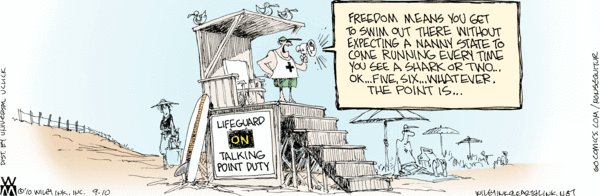
Cartoon: Freedom v. the Nanny State

Friday, September 10, 2010

Why the Bush Tax Cuts Worked

Jeffrey Miron writes:

Extending the Bush tax cuts — permanently — is a crucial step in restoring economic growth. The Bush cuts provided lower taxes on ordinary income, especially for taxpayers at the high end of the income distribution. These are some of the most energetic and productive people in society; raising tax rates would discourage their effort and entrepreneurship. High-income taxpayers also have multiple ways of avoiding high tax rates, so any revenue gain from raising rates would be modest.

The Bush cuts also lowered taxes on dividend and capital gains income; maintaining these lower rates is even more important for economic performance. Capital is mobile: when it is taxed heavily here, it flees somewhere else, meaning lower investment and employment in the United States. And because capital income taxes discourage investment or drive it overseas, they generate little if any tax revenue.

Opponents of the tax cuts do not seriously dispute these claims about the productivity benefits of lower rates. Instead, their real objection is that the Bush tax cuts (allegedly) favor the wealthy.

read the entire essay

Wednesday, September 8, 2010

Unemployment Above 9%


The early 1980s offer a reminder. Unemployment climbed above 9% in March 1982—peaking at 10.8% in late 1982—and stayed there for 19 months. Today's rate has hovered above 9% for only 16 months and peaked at 10.1% in October 2009. Even worse, while unemployment fell below 9% in October 1983, its stretch above 7% lasted from May 1980 until January 1986.

source

Personal Spending by Category


source

Cartoon: Cracking the Nest Egg


Tuesday, September 7, 2010

Cartoon: Stock Market and Casinos

Investing Advice

The Mogambo Guru writes:

But, back to business, I gently remind you to buy gold, silver and oil stocks against the idiocy of your government deficit-spending so much money and the inflationary calamity of the Federal Reserve creating the money.

And if you don’t buy gold, silver and oil after I gently reminded you, then I will not so gently remind you that you are an idiot! You are worse than an idiot! You are a lowlife imbecile! And you will grow old and die in penniless misery because you act like an idiot, and your children will curse you for being so stupid as to not buy gold, silver and oil when it was obviously the correct thing to do, and they will drive you from their doors when you beg for crusts of bread.

So, think about it; gold, silver and oil, or begging for crumbs from your own children who hate your guts. Seems like a no-brainer to me! Whee!

read the entire essay

Monday, September 6, 2010

Cartoons: Supply and Demand


I Can Solve the Puzzle, But I Can't Read It Correctly

Jim Rogers on the Economy and Bernanke

Speaking to CNBC earlier this week, Rogers said: “In America, Bernanke just says we'll print more money, we'll spend more money, even though the United States is now the largest debtor nation in the history of the world."

"The things that have worked in the past... will be you go bankrupt then you re-organize and you start over. You have a painful period for awhile, and then you start over. This has been done in the past 3-4 thousand years, and that's the way you do it," said Rogers.

"Trying to push the problem out to the future, and printing money, we just had another example here in the US, it didn't work and it's not going to work."

Rogers said that with central banks "flooding the world with money," the only place for investors right now is in real assets, to protect themselves from central banks debasing currencies.

"Paper money is not going to do it for you," he added.

Rogers said central banks are destroying the saving and investing class. “We’re going to have a lot more currency turmoil over the next 2-3 years because of the huge imbalances that exist in the world.”...

“Mr. Bernanke has never been right about anything,” said Rogers, adding that the Fed chairman "doesn’t understand economics, finance, or currencies and is merely pushing the problem to the future by printing more money," Rogers told CNBC...

While he doesn’t call this a double dip, as “we never got out of the first recession,” he does say that “the next time it’s going to be worse because we’ve shot all of our bullets.”

"With zero interest rates and huge government deficits all around, policy options are definitely more limited," Rogers said.

read the entire article

Gulf Diaster and Free Market Solutions

Walter Block writes:

The BP Deepwater Horizon oil rig explosion of April 20, 2010 was a disaster for people located in or near the Gulf of Mexico. It outright killed 11 platform workers and seriously injured 17 others. It played havoc with the economic welfare of people in states stretching from Texas to Florida (none of which apart from Florida voted for Obama). But it was a great boon for socialists who like nothing more than to bash the free enterprise system...

What suggestion emanates from market fundamentalists such as me? Why, to privatize the entire Gulf of Mexico, of course. Why? Because with private ownership, external costs would be internalized. Any owner of the Gulf would have been much more careful than the MMS, because he would have lost, wait for it, profits! Had the Mississippi river been in private hands, the corporate owner would have gone broke, and this property turned over to more capable hands in the advent of the Katrina tragedy. Instead, those responsible for killing some 1500 of our neighbors, FEMA and the Army Corps of Engineers, are still in existence. This is in sharp contrast to BP, which of course, is (partially) responsible for this disaster. But, happily, based on free enterprise principles, that firm will suffer losses and even risk bankruptcy, unlike these statist institutions.

Ideally, users of the Gulf, its homesteaders, would become its owners. As a second best policy all those living within say, five miles of its coast, plus intensive users of its waters, would become stockholders in a new Gulf of Mexico Corporation. Take that, pinkos. If we learn anything from the study of economics, it is that private property rights systems, while far from perfect, function markedly better than their alternative, nonownership or government ownership.

read the entire essay

Cartoon: Fishing

Friday, September 3, 2010

August Unemployment Rate 9.6%


The Labor Department reported that nonfarm payrolls declined by 54,000 in August and the unemployment rate rose to 9.6 percent. The overall decline was driven by the departure of 114,000 temporary 2010 Census workers and private sector payrolls rose by 67,000.

source

Health Care Insurance


source

August 2010 Unemployment: 9.6%


For the current employment recession, employment peaked in December 2007, and this recession is by far the worst recession since WWII in percentage terms, and 2nd worst in terms of the unemployment rate (only early '80s recession with a peak of 10.8 percent was worse).

source

Unemployment August 2010: 9.6%


The Employment-Population ratio increased to 58.5% in August from 58.4% in July.

The Labor Force Participation Rate increased to 64.7% from 64.6% in July.

The number of persons employed part time for economic reasons (sometimes referred to as involuntary part-time workers) increased by 331,000 over the month to 8.9 million.

According to the BLS, there are 6.249 million workers who have been unemployed for more than 26 weeks and still want a job.

source

Bureaucracy


Thursday, September 2, 2010

Worst Auto Sales in 27 Years

Yesterday, automakers in the U.S. reported the worst sales since 1983 and not even the ongoing troubles at Toyota seem to have been able to cushion the fall, the graphic below from this story at CNN/Money offering a reminder of how much the “Cash for Clunkers” program boosted sales last year.

source

Food Consumption


source

Investing in Gold

Bill Bonner writes:

The only reliable bull market of the last ten years has been in gold. The yellow metal lost $2 yesterday, closing at $1,248. That is only $14 below its all-time high. Which means, while we’ve been watching Bernanke, Jackson Hole, and stocks – gold has been quietly creeping up…

…stocks go down; stocks go up – and gold keeps moving up…

…fiscal stimulus, monetary stimulus, quantitative easing – and gold keeps moving up…

…recovery…no recovery – gold keeps moving up…

…inflation…deflation – and gold keeps moving up…

Are you beginning to see a pattern?

Yes, gold is in a bull market. It moves up on bad news. It moves up on good news. It moves up on no news at all...

But here’s the important thing. Gold is money. You can use it to buy things. In terms of what gold will buy, it does not seem undervalued to us. Much has been written on the subject. But as near as we can tell, gold is now fairly priced.

Go ahead; buy all you want. It is a good way to maintain your wealth and protect it against the monetary and economic calamities that are doubtless coming. And if you expect to make a lot of money on it, you’ll probably succeed. When the Bernanke Fed loses its grip – which it will – and when the public gets on board the gold bull market – which it will – gold speculators will probably make a lot of money.

We’ve been a gold bug for the last 30 years. Two thirds of that time was miserable, punishing and humiliating. Only the last 10 years have been rewarding. We expect the next 10 years to be even more rewarding.

But the reward now is different. It is speculative…not inherent. When we bought gold in ’99, we were buying an undervalued asset. We were buying real money, cheap. We made our money when we bought.

Now, gold is fully priced. It is a still a good way to save money. But we cannot expect to make money by waiting for the metal to revert to the mean. It’s already at the mean. Gold is now a speculation.

A warning: we still have not had the sell-off in the financial markets that we expect. The Dow has still not sunk down to 5,000. The lights are still on at banks that should have been put out of business months ago. The public still believes another “stimulus” effort might do the trick. Leading economists still believe they can manage the economy back to growth and prosperity.

We have not hit bottom yet. Far from it.

When we do, the price of gold could be substantially lower. Which is okay with us. We bought years ago. We’re happy with our gold holdings and don’t really care if the price drops. Heck, we’d be happy to see the price back below $1,000; we’d buy more.

source

How Do LIke Them Apples?

The Mogambo Guru writes:

I am standing on the corner of the street, doing my duty to “give back” to society, in this case by yelling at morons passing by in the cars, “We’re freaking doomed, you moron! Your own stupid government has destroyed you by letting the foul, fetid, festering Federal Reserve create too much money that they stupidly, stupidly, stupidly did as part of the stupid neo-Keynesian econometric theoretical lunacy that has mesmerized them, so that a shiny computer in front of a neo-Keynesian econometric economist is like a shiny toy in front of a monkey, and which has mesmerized the Fed and the government for similar reasons, and with similar results, in that the toy is now broken, the monkey cut its hand on the broken toy, the cut is infected, and there is a good chance that the monkey will die a horrible, painful death! Hahaha! How do you like them apples? Horrible, painful death! We’re freaking doomed, including you and your hotshot car with the radio turned up real loud, trying to drown me out! And stop honking at me! I have rights, you moron!”...

Even Gene Epstein, in his Economic Beat column in Barron’s, seems so moved by the threat of inflation in prices that he makes a joke of it by humorously saying, “It seems to have become an article of faith: Cheaper goods and services are bad for us, costlier goods and services much healthier,” which is the only conclusion that one can draw from how “Federal Reserve Chairman Ben S. Bernanke expressed concern that price inflation isn’t running fast enough”!!!

The three exclamation points that I included at the end of that last sentence perform a variety of functions, the most important is that it indicates proof that Ben Bernanke is a treacherous, traitorous bastard, in that he is deliberately violating the reason that the Federal Reserve exists in the first place; to prevent inflation in prices!


A New Stimulus?

Bill Bonner writes:
Wolf, Stiglitz, Krugman – we love these guys!

They pushed the world’s governments to undertake huge “stimulus” programs. Of course, the stimulus programs didn’t work. They couldn’t work. All they could do was to disguise the facts and delay the necessary adjustments.

But these fellows don’t care about that. They are the technicians, scientists, and engineers of finance. They have measures of financial health – GDP, employment, inflation, etc. They may not be able to make anyone better off…but they can damned sure move those indicators. At least, they believe they can.

Spend enough money and you can move the GDP up. Hire enough people and you can get unemployment down. It’s not that complicated.

So, the engineers went to work two years ago. You know the rest of the story. That is how we got where we are. They turned valves. They connected wires. They adjusted dials and switches. They put at risk nearly an entire year’s worth of US GDP – on the idea that an economy can be controlled and managed, just as if it were a brewery...

The trouble is…managing an economy is not science at all. And these guys are not scientists. They have no controlled experiments. They have no test panels nor test results. They have no peer reviews. They have no proper theories – none that can be disproven or confirmed. They just have crackpot ideas and quack treatments.

And now, Paul Krugman is on television in the US calling for another $800 billion program of boondoggles, bailouts and bumph. “Stimulus,” he calls it. Claptrap is what it is.

Cartoon: Lobbyists

Cartoon: Foreclosures

Cartoon: Employee Survey


Economic Freedom: US #8

Fundamentally, there are only two ways of co-ordinating the economic activities of millions. One is central direction involving the use of coercion—the technique of the army and of the modern totalitarian state. The other is voluntary co-operation of individuals—the technique of the market place.

—Milton Friedman

Measuring Economic Freedom
The measurement of economic freedom in countries as different as Hong Kong and North Korea, Zimbabwe and Singapore, or Australia and Cuba presents formidable challenges. As the number and variety of countries included in the Index have increased, it has become ever more difficult to find consistent and reliable data. We are indebted to the various international organizations, both governmental and non-governmental, that have undertaken the arduous task of data collection in their various areas of focus and have shared their data with us.
The Index of Economic Freedom is comprehensive in its view of economic freedom as well as in its worldwide coverage of countries. The Index looks at economic freedom from 10 different viewpoints. Some aspects of economic freedom are external in nature, measuring the extent of an economy’s openness to global investment or trade. Most are internal in nature, assessing the liberty of individuals to use their labor or finances without restraint and government interference. Each is vital to the development of personal and national prosperity. The fundamental right of property, for example, has been recognized for centuries by the great philosophers of liberty, such as Locke and Montesquieu, as a bulwark of free people.
Over time, scholars and practitioners have recognized many other pillars of economic liberty, including free trade, stable money, the right to work, control of government spending, and lower taxation. Each one illuminates some aspect of the relationship between the individual and the state, and all should be viewed in light of the fundamental principles of economic liberty—individual empowerment, non-discrimination, and open competition—outlined above.
The 10 specific economic freedoms measured in the Index of Economic Freedom are discussed below. Each of the freedoms is individually scored on a 0 to 100 scale. A country’s overall economic freedom score is a simple average of its scores on the 10 individual freedoms. Detailed information about the methodology used to score each component is contained in the appendix.

Freedom #1: Business Freedom
Business freedom is about an individual’s right to establish and run an enterprise without interference from the state. Burdensome and redundant regulatory rules are the most common barriers to the free conduct of entrepreneurial activities.
By increasing the costs of production, regulations can make it difficult for entrepreneurs to succeed in the marketplace. Although many regulations hinder business productivity and profitability, the most inhibiting to entrepreneurship are those associated with licensing new businesses.
In some countries, as well as many states in the United States, the procedure for obtaining a business license can be as simple as mailing in a registration form with a minimal fee. In Hong Kong, for example, obtaining a business license requires filling out a single form, and the process can be completed in a few hours. In other economies, such as India and parts of South America, the process of obtaining a business license can take much longer, involving endless trips to government offices and repeated encounters with officious and sometimes corrupt bureaucrats.
Once a business is open, government regulation may interfere with the normal decision-making or price-setting process. Interestingly, two countries with the same set of regulations can impose different regulatory burdens. If one country, for instance, applies its regulations evenly and transparently, it lowers the regulatory burden by enabling businesses to make long-term plans more easily. If the other applies regulations inconsistently, it raises the regulatory burden by creating an unpredictable business environment. Finally, regulations that make bankruptcy procedures onerous are also distortionary, providing disincentives for entrepreneurs to start businesses in the first place.

Freedom #2: Trade Freedom
Trade freedom reflects the openness of an economy to imports of goods and services from around the world and the ability of citizens to interact freely as buyers and sellers in the international marketplace.
Trade restrictions can manifest themselves in the form of taxes on imports and exports and quotas or outright bans on trade. However, trade restrictions also appear in more subtle ways, particularly in the form of regulatory barriers. The degree to which government hinders the free flow of foreign commerce has a direct bearing on the ability of individuals to pursue their economic goals and to maximize their productivity and well-being.
Tariffs, for example, directly increase the prices that local consumers pay for foreign imports, but they also distort production incentives for local producers, causing them to produce either a good in which they lack a comparative advantage or more of a protected good than is economically efficient. This impedes overall economic efficiency and growth. In many cases, trade limitations also put advanced-technology products and services beyond the reach of local entrepreneurs, limiting their own productive development.

Freedom #3: Fiscal Freedom
Fiscal freedom is a direct measure of the extent to which individuals and businesses are permitted by government to keep and control their income and wealth for their own benefit and use. A government can impose fiscal burdens on economic activity through taxation, but it also does so when it incurs debt that ultimately must be paid off through taxation.
The marginal tax rate confronting an individual is, in effect, the government’s cut of the profit from his or her next unit of work or engagement in a new entrepreneurial venture; whatever remains after the tax is subtracted is the individual’s actual reward for the effort. The higher the government’s cut, the lower the individual’s reward—and the lower the incentive to undertake the work at all. Higher tax rates interfere with the ability of individuals and firms to pursue their goals in the marketplace and reduce, on average, their willingness to work or invest.
While individual and corporate income tax rates are important to economic freedom, they are not a comprehensive measure of the tax burden. Governments impose many other indirect taxes, including payroll, sales, and excise taxes, tariffs, and the value-added tax (VAT). In the Index of Economic Freedom, the burden of these taxes is captured by measuring total government revenues from all forms of taxation as a percentage of total GDP.

Freedom #4: Government Spending
The burden of excessive government is a central issue in economic freedom, both in terms of generating revenue (see fiscal freedom) and in terms of spending. Some government spending, such as providing infrastructure or funding research or even improvements in human capital, may be thought of as investments. There are public goods whose benefits accrue broadly to society in ways that markets cannot appropriately price. All government spending, however, entails an opportunity cost equal to the value of the private consumption or investment that would have occurred had the resources involved been left in the private sector.
In other words, excessive government spending runs a great risk of crowding out private consumption, thereby thwarting the choices of individuals. Even worse, a government’s insulation from market discipline often leads to inefficiency, bureaucracy, lower productivity, and waste.
The government’s appetite for private resources affects both economic freedom and economic growth. Even if a state-managed economy achieves fast growth through heavy expenditure, it diminishes economic freedom in the process and can create long-term damage to a country’s growth potential.

Freedom #5: Monetary Freedom
Monetary freedom, reflected in a stable currency and market-determined prices, is to an economy what free speech is to democracy. Free people need a steady and reliable currency as a medium of exchange, unit of account, and store of value. Without monetary freedom, it is difficult to create long-term value or amass capital.
The value of a country’s currency is controlled largely by the monetary policy of its government. With a monetary policy that endeavors to fight inflation, maintain price stability, and preserve the nation’s wealth, people can rely on market prices for the foreseeable future. Investments, savings, and other longer-term plans can be made more confidently. An inflationary policy, by contrast, confiscates wealth like an invisible tax and also distorts prices, misallocates resources, and raises the cost of doing business.
There is no single accepted theory of the right monetary policy for a free society. At one time, the gold standard enjoyed widespread support. What characterizes almost all monetary theories today, however, is support for low inflation and an independent central bank. There is also now widespread recognition that price controls corrupt market efficiency and lead to shortages or surpluses.

Freedom #6: Investment Freedom
A free and open investment environment provides maximum entrepreneurial opportunities and incentives for expanded economic activity, productivity increases, and job creation. The benefits of such an environment flow not only to the individual companies that take the entrepreneurial risk in expectation of greater return, but also to society as a whole.
An effective investment framework will be characterized by transparency and equity, supporting all types of firms rather than just large or strategically important companies, and will encourage rather than discourage innovation and competition.
Restrictions on the movement of capital, both domestic and international, undermine the efficient allocation of resources and reduce productivity, distorting economic decision-making. Restrictions on cross-border investment can limit both inflows and outflows of capital, shrinking markets and reducing opportunities for growth.
In an environment in which individuals and companies are free to choose where and how to invest, capital will flow to its best use: to the sectors and activities where it is most needed and the returns are greatest. State action to redirect the flow of capital and limit choice is an imposition on the freedom of both the investor and the person seeking capital. The more restrictions a country imposes on investment, the lower its level of entrepreneurial activity.

Freedom #7: Financial Freedom
A transparent and open financial system ensures fairness in access to financing and promotes entrepreneurship. An open and free banking environment encourages competition to provide the most efficient financial intermediation between households and firms and between investors and entrepreneurs.
In an efficient banking environment that facilitates open and transparent access to financing, the marketplace is the primary source of protection for all parties involved in a financial transaction. Through a process driven by supply and demand, markets provide real-time information on prices and immediate discipline for those who have made bad decisions. This process depends on transparency in the market and the integrity of the information being made available. An effective regulatory system, through disclosure requirements and independent auditing, ensures both.
Increasingly, the central role played by banks is being complemented by other financial services that offer alternative means for raising capital or diversifying risk. As with the banking system, the useful role for government in regulating these institutions lies in ensuring transparency; disclosure of assets, liabilities, and risks; and ensuring integrity.
Banking and financial regulation by the state that goes beyond the assurance of transparency and honesty in financial markets can impede efficiency, increase the costs of financing entrepreneurial activity, and limit competition. If the government intervenes in the stock market, for instance, it contravenes the choices of millions of individuals by interfering with the pricing of capital—the most critical function of a market economy. Equity markets measure, on a continual basis, the expected profits and losses in publicly held companies. This measurement is essential in allocating capital resources to their highest-valued uses and thereby satisfying consumers’ most urgent requirements.
Similarly, government ownership or intervention in the insurance sector undermines the ability of providers to make that service available at prices that are based on risk and market conditions.

Freedom #8: Property Rights
The ability to accumulate private property and wealth is understood to be a central motivating force for workers and investors in a market economy. The recognition of private property rights, with sufficient rule of law to protect them, is a vital feature of a fully functioning market economy. Secure property rights give citizens the confidence to undertake entrepreneurial activities, save their income, and make long-term plans because they know that their income, savings, and property (both real and intellectual) are safe from unfair expropriation or theft.
The protection of private property requires an effective and honest judicial system that is available to all, equally and without discrimination. The independence, transparency, and effectiveness of the judicial system have proven to be key determinants of a country’s prospects for long-term economic growth. Such a system is also vital to the maintenance of peace and security and the protection of human rights.
A key aspect of property rights protection is the enforcement of contracts. The voluntary undertaking of contractual obligations is the foundation of the market system and the basis for economic specialization, gains from commercial exchange, and trade among nations. Even-handed government enforcement of private contracts is essential to ensuring equity and integrity in the marketplace.

Freedom #9: Freedom from Corruption
Corruption is defined as dishonesty or decay. In the context of governance, it can be defined as the failure of integrity in the system, a distortion by which individuals are able to gain personally at the expense of the whole. Political corruption manifests itself in many forms such as bribery, extortion, nepotism, cronyism, patronage, embezzlement, and, most commonly, graft, whereby public officials steal or profit illegitimately from public funds.
Corruption can infect all parts of an economy; there is a direct relationship between the extent of government regulation or other government intervention in economic activity and the amount of corruption. Almost any government regulation can provide an opportunity for bribery or graft. In addition, a government regulation or restriction in one area may create an informal market in another. For example, a country with high barriers to trade may have laws that protect its domestic market and prevent the import of foreign goods, but these barriers create incentives for smuggling and a black market for the restricted products.
Transparency is the best weapon against corruption. Openness in regulatory procedures and processes can promote equitable treatment and greater regulatory efficiency and speed.

Freedom #10: Labor Freedom
The ability of individuals to work as much as they want and wherever they want is a key component of economic freedom. By the same token, the ability of businesses to contract freely for labor and dismiss redundant workers when they are no longer needed is a vital mechanism for enhancing productivity and sustaining overall economic growth. The core principle of any market is free, voluntary exchange. That is as true in the labor market as it is in the market for goods.
State intervention generates the same problems in the labor market that it produces in any other market. Government regulations take a variety of forms, including wage controls, hiring and firing restrictions, and health and safety restrictions. In many countries, unions play an important role in regulating labor freedom and, depending on the nature of their activity, may be either a force for greater freedom or an impediment to the efficient functioning of labor markets. In general, the greater the degree of labor freedom, the lower the rate of unemployment in an economy.

source

Cartoon: Retirement


Cartoon: The Recovery


Wednesday, September 1, 2010

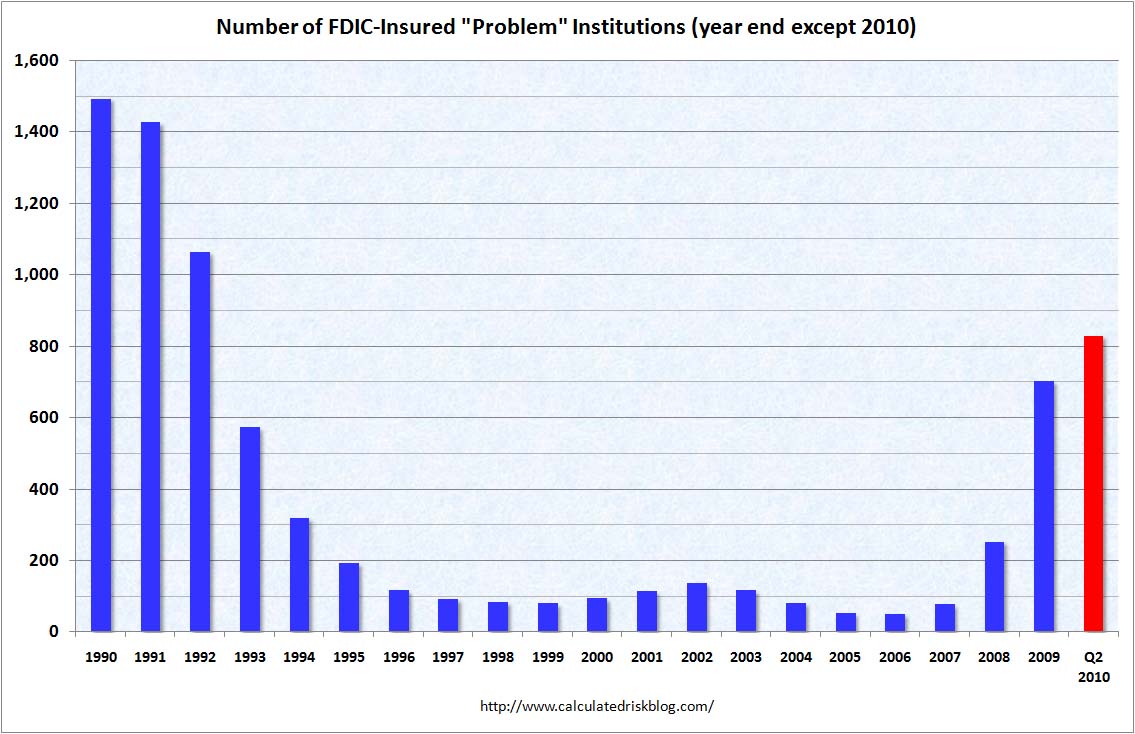
Problem Banks: 829


The FDIC listed 829 banks with $403 billion in assets as “problem” banks in Q2, up from 775 banks in Q1 2010, but the total assets declined from $431 billion in assets in Q1 2010.

There were 702 banks with $403 billion in assets on the list at the end of 2009.

source

Restaurant Performance July 2010


The Association’s Restaurant Performance Index (RPI) – a monthly composite index that tracks the health of and outlook for the U.S. restaurant industry – stood at 99.4 in July, down 0.1 percent from June and its fourth consecutive decline...

Restaurants are a discretionary expense, and this contraction could be because of the sluggish recovery or might suggest further weakness in consumer spending in the months ahead.

source