source
Now, Harvard's Niall Ferguson, one of the world's leading financial historians, echoes Diamond's warning: "Imperial collapse may come much more suddenly than many historians imagine. A combination of fiscal deficits and military overstretch suggests that the United States may be the next empire on the precipice." Yes, America is on the edge.
Dismiss his warning at your peril. Everything you learned, everything you believe and everything driving our political leaders is based on a misleading, outdated theory of history. The American Empire is at the edge of a dangerous precipice, at risk of a sudden, rapid collapse...
Ferguson's final message about America's destiny comes from Foreign Affairs: "Conceived in the mid-1830s, Cole's great five-part painting has a clear message: all empires, no matter how magnificent, are condemned to decline and fall." Throughout history, empires function "in apparent equilibrium for some unknowable period. And then, quite abruptly ... collapse," a blunt reminder of the sudden, swift, silent, certain timetable in Diamond's "Collapse" where a "society's demise may begin only a decade or two after it reaches its peak population, wealth and power."
You are forewarned: If the peak of America's glory was the leadership handoff from Clinton to Bush, then we have already triggered the countdown to collapse, the decade from 2010 until 2020 ... tick ... tick ... tick ...Now that the real estate bubble has burst, the Fed is inflating the biggest bubble of them all – a bubble in government. While the earlier booms at least provided the illusion of prosperity and some fun while they lasted, the government bubble will cripple the economy and deliver widespread misery to the vast majority of Americans...
Our economy is being transformed from a mostly capitalistic one to a mostly socialistic one. More decisions are being made by politicians and lawyers in Washington and fewer by entrepreneurs. The motivation behind this shift is the mistaken belief that the financial crisis of 2008 was caused by too much capitalism and a lack of proper government oversight. This conclusion is self-serving for those in power, and couldn't be more economically misguided. Through corruption or just plain ignorance, Congress and this Administration have embraced an ideology that has failed every time it has been tried...Whether it is in education, housing, health care, automobiles, insurance, or banking, greater government involvement in the economy means higher prices, lower productivity, more bailouts, bigger deficits, increased taxes, diminished industrial capacity, fewer private sector jobs, less freedom, and a falling standard of living.
In the end, when runaway inflation and skyrocketing interest rates burst the government bubble, there will be no more bubbles to replace it – just one hell of a hangover.
source
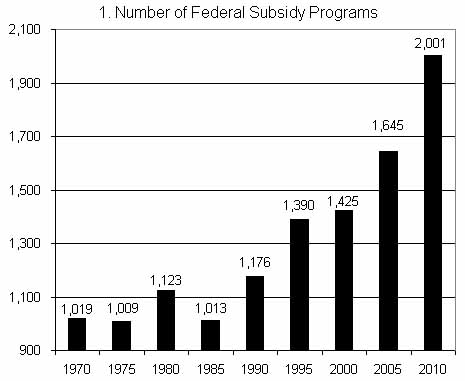
 Most people are aware that federal spending is soaring, but the federal government is also increasing the scope of its activities, intervening in many areas that used to be left to state governments, businesses, charities, and individuals...
 The unemployment rate held steady at 9.7 percent, however, the broader U6 measure of under-employment – including those who have stopped looking for work and those settling for part-time work instead of full-time work – rose for the second straight month, from 16.8 percent to 16.9 percent.
 When “discouraged” workers begin actively looking for work again, the unemployment rate is expected to rise.
source

 According to the BLS, there are a record 6.55 million workers who have been unemployed for more than 26 weeks (and still want a job). This is a record 4.3% of the civilian workforce. (note: records started in 1948)
What the Federal Reserve still fails to realize is that intervention in the economy is always harmful. Unlike the late French economist, Frederic Bastiat, the Fed only sees what is seen, the superficial results of its policies, and not what is unseen, the effects of its monetary intervention throughout the economy. Monetary inflation leads to malinvestment and causes the boom phase of the business cycle. Once the malinvestment is realized the bust phase occurs, and these malinvested resources need to be liquidated in order for the economy to recover. But the Fed actively works to prevent this liquidation and does everything in its power to continue inflating in order to prolong the boom. The first act of intervention begets the second and subsequent interventions, each bigger than the first, as each economic bust gets larger and more severe.
The idea that a handful of brilliant minds can somehow steer the economy is fatal to economic growth and stability. The Soviet Union's economy failed because of its central planning, and the United States economy will suffer the same fate if we continue down the path toward more centralized control. We need to return to sound money, bring back free markets, and rein in the Fed.
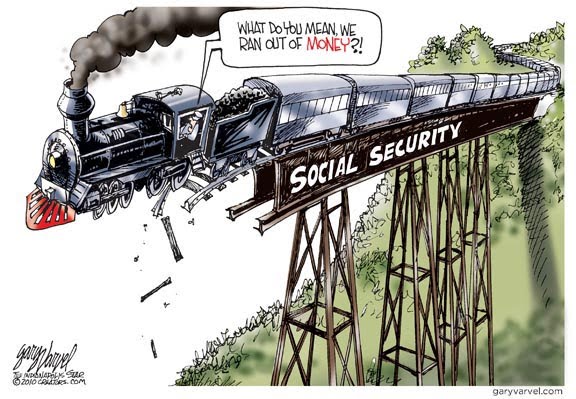
 This year, the system will pay out more in benefits than it receives in payroll taxes, an important threshold it was not expected to cross until at least 2016, according to the Congressional Budget Office...
Although Social Security is often said to have a “trust fund,” the term really serves as an accounting device, to track the pay-as-you-go program’s revenue and outlays over time. Its so-called balance is, in fact, a history of its vast cash flows: the sum of all of its revenue in the past, minus all of its outlays. The balance is currently about $2.5 trillion because after the early 1980s the program had surplus revenue, year after year.
Now that accumulated revenue will slowly start to shrink, as outlays start to exceed revenue. By law, Social Security cannot pay out more than its balance in any given year.
sourceGovernment is a profoundly reactionary institution. It always favors its current clients – the present generation of taxpayers – over its clients of the future (who don’t pay taxes and don’t lobby). It provides protection against foreign invaders and domestic troublemakers. It also attempts to give its clients protection against the future.
Taxpayers want government to protect their existing assets…their businesses…their claims…their jobs…their franchises against all threats. In the modern world, most of those threats come in the form of economic and technological change. That’s why taxpayers demand subsidies and bailouts. It’s also why they like regulation. Anything that will keep change from diminishing what they’ve got.
A properly-functioning economy, as Schumpeter described it, is a process of incremental growth and also of creative destruction…in which old industries, old technologies and old institutions are blown up by change. This is what people pay their taxes to avoid. The present generation wants the government to “do something” to protect them from this process. It’s why they are perfectly happy to see the government take over the whole economy, if necessary, in order to prevent capitalism from happening.