 source
Sunday, June 12, 2011


Saturday, June 11, 2011

Richard Maybury on Austrian Economics
"The Austrian economists point out that the economy is not a machine, it is an ecology composed of living organisms, people. The Austrian school is in the forefront of the effort to expose the madness of the government's Keynesian and socialist policies."
read the essay
read the essay
The Next Crisis or the Continuation of the Current Crisis
Gary North writes:
The mainstream financial media are running stories on the next financial crisis. This is unheard of two years into a so-called economic recovery. So weak is this recovery that the old pre-2008 confidence has not returned...
We are being warned in advance by the financial media: expect another major crisis. The bailouts were not enough. The expansion of the monetary base was not enough. The new Dodd-Frank regulatory structure is not enough...There is no formula to deal with this. There is no organized government response that is waiting in the wings. There will be another crisis. And when it comes, the response will be the same: to preserve the solvency of the biggest banks, at taxpayer expense and at central bank expense. When it comes to bailouts and central bank inflation, it's all "doable." It will therefore be done.
source
Friday, June 10, 2011

Thursday, June 9, 2011

Wednesday, June 8, 2011
Bernanke's Speech on the Economy
Here is the transcript.
Mish Shedlock provides some usefully commentary.
At the same time, the longer-run health of the economy requires that the Federal Reserve be vigilant in preserving its hard-won credibility for maintaining price stability.My thoughts: Ha!! Credibility for maintaining price stability? The dollar has lost over 95% of its purchasing power since the Fed was created. That is called failure!!
Mish Shedlock provides some usefully commentary.
Bernanke did everything possible to mitigate his role and the Fed's role in this crisis. His unmitigated gall comes through loud and clear with this bald-faced lie:source
"The Federal Reserve's actions in recent years have doubtless helped stabilize the financial system, ease credit and financial conditions, guard against deflation, and promote economic recovery. All of this has been accomplished, I should note, at no net cost to the federal budget or to the U.S. taxpayer."
For starters, were it not for the complete ineptitude of the Greenspan and Bernanke Fed the US would not be in this mess in the first place. Second, there most assuredly is a cost to the Fed's policies.
Prices are higher, wages are not. Banks were bailed out at taxpayer expense. The Fed pays interest on reserves. That interest comes from taxpayers. The Fed's balance sheet is loaded to the gills with garbage from Fannie Mae and Freddie Mac. The Fed is not at risk on that garbage because Congress approved unlimited backing for GSE debt. That unlimited backing is over $300 billion and counting. Those losses are not all on the Fed's balance sheet of course. However let's not ignore the Fed's role in getting Congress to pass that blatantly stupid bill.
Let's also not forget the Fed cheerleading fiscal stupidity in Congress, not wanting Congress to do anything about monstrous deficits now. Keynesian and Monetarist clowns never want to do anything now. They always want to do it at the "appropriate" time, which in practice means never.
Most importantly I would like to point out the very real cost of those on fixed income, attempting to get by with higher food prices, higher gasoline prices, etc. I dare Ben Bernanke to face senior citizens and tell them there is no cost associated with interest rates at 0%.
In case you missed it please read Hello Ben Bernanke, Meet "Stephanie". That post is about the plight of those on fixed incomes struggling to get by with rising costs and CD rates at 1%.
Finally, there is an unseen cost to the stupidity of Bernanke's policies. That unseen cost is the cost associated with fostering still more speculation in the financial markets. There is another bubble in the stock market, another bubble in junk bonds, and another bubble in commodities.
We have yet to feel the ramifications when those bubble pop, and they will. Bernanke cannot see those bubbles for the same reason he could not see the bubble in housing, the bubble in credit, the rapidly rising unemployment rate, and countless other things he missed.
Bernanke is a complete fool, trapped in academic wonderland, completely oblivious as to how the real world works. To top it off, Bernanke has the gall to knowingly lie about the real world effects of his blatant stupidity.
Ben Bernanke, you are disgusting.


Tuesday, June 7, 2011

Monday, June 6, 2011

Sunday, June 5, 2011

Friday, June 3, 2011
May 2011 Unemployment: 9.1%

The Labor Department reported that nonfarm payrolls rose by just 54,000 in May, far below expectations for a gain of more than 150,000, and the jobless rate rose from 9.0 percent to 9.1 percent, adding to the recent gloom about the U.S. economy that, with each new report, appears to have entered a “soft patch” or, perhaps, something more serious.
source

Thursday, June 2, 2011

Wall Street, Banks, and American Foreign Policy
 A new introduction by Anthony Gregory.
Gregory writes:
The idea that corporate interests, banking elites, and politicians conspire to set US policy is at once obvious and beyond the pale. Everyone knows that the military-industrial complex is fat and corrupt, that presidents bestow money and privilege on their donors and favored businesses, that a revolving door connects Wall Street and the White House, and that economic motivations lurk behind America's wars. But to make too fine a point of this is typically dismissed as unserious conspiracy theorizing, unworthy of mainstream consideration.
We have seen this paradox at work in the aftermath of the 2008 financial collapse. The left-liberals blame Wall Street and Big Finance for betraying the masses out of predatory greed and for being rewarded for their irresponsibility by Washington's bailouts. At the same time, the Left appears reluctant to oppose these bailouts outright, seeing the spending as a necessary evil to return the global economy to stability, however inequitably. What's more, left-liberals fail to call out President Obama and Democratic leaders for their undeniable hand in all this. They blame Goldman Sachs but see their president, who got more campaign money from the firm than from almost any other source, as a helpless victim of circumstance, rather than an energetic conspirator in corporate malfeasance on top of being the enthusiastic heir and expansionist of George W. Bush's aggressive foreign policy.
The tea-party Right is also hesitant to examine the corporate state too closely. These conservatives detect an elitism in Obama's governance but are loath to earnestly challenge the economic status quo, for it would lead to uncomfortable questions about the warfare state, defense contractors, US wars, the whole history of the Republican Party, and all the typical right-wing assumptions about the inherent fairness of America's supposedly "free-enterprise" system. By refusing to admit that economic fundamentals were unsound through the entirety of the Bush years — by failing to acknowledge the imperial reality of US wars and their debilitating effect on the average household budget — the Right is forgoing its chance to delve beyond the surface in its criticism of Obama's reign.
Wednesday, June 1, 2011
The Framework
The Framework: Explained from Mises Media on Vimeo.
These are the books that built the austro-libertarian movement as we know it - all available in the perfect size and for the right price.
There was a time when a month's salary couldn't acquire these books - if you could find them. And then they were also huge and unwieldy.
We've fixed that with these brilliant and fun pocket editions. So now you can have Mises's masterpiece, Rothbard's masterpiece, the works of Bastiat, and the best case for monetary reform by the greatest statesman of liberty ever - and all for $40. That's a total of 4,000 pages!
The Mises Institute worked very hard to make these books right - in terms of binding and printing. And now we see the payoff: uniform sizes in this incredible size.
This is the collection to own, gift, and read for a lifetime.
Tuesday, May 31, 2011

Monday, May 30, 2011


Real Personal Income and GDP
 real personal income less transfer payments is still 3.4% below the previous peak.
 It appears that GDP bottomed in Q2 2009 and GDI in Q3 2009. Real GDP finally reached the pre-recession peak in Q4 2010, but real GDI is still slightly below the previous peak.
Using GDI, the economy will be back to the pre-recession peak in Q2 2011.
source

Great Recession Unemployment
 This shows the severe job losses during the recent recession - there are currently 6.96 million fewer jobs in the U.S. than when the recession started in 2007.
source
Friday, May 27, 2011
DiLorenzo on Central Banking
A Note on the Machiavellian Origins of Central Banking in America
Thomas J. DiLorenzo
Thomas J. DiLorenzo
ABSTRACT: In The Mystery of Banking, Murray Rothbard explained how the origins of central banking in the U.S. were rooted in a lobbying effort by Robert Morris and other “nationalists” to create a bank modeled after the Bank of England that would subsidize their businesses with cheap credit and other forms of corporate welfare. This paper argues that there was more to it than that, namely, that the chief proponent of a central bank, Alexander Hamilton, wanted the bank to be a more comprehensive engine of political corruption because of his belief that, without such corruption, government would be too small and ineffective. Members of Congress had to be “bought off” if they were to support the nationalists’ economic agenda, Hamilton believed, and a central bank was necessary to achieve that goal.read the entire paper
Thursday, May 26, 2011

Free Market Solutions
Mark Thornton writes:
read the entire essayPeople often ask me, "What do you think the government should do instead of QE inflation?" My stock answer is that the government should not try to fight the depression with government spending and cheap credit. Trying to stop the market from correcting the errors of the past only delays the consequences and makes them much worse.
Government should balance its budget. There should be no new credit expansion by the Federal Reserve. Most importantly, government should not meddle in markets to try to soften the consequences of the correction. Specifically, that means no bailouts, stimulus packages, or new public-works projects. Do not prop up wages. Allow competition to lower the prices of land, labor, and capital. The only positive steps for government to take are implementing tax cuts and spending cuts, eliminating regulations, and allowing free trade.
Now, I have a name for this policy. It's called the "Lehman Bros. plan," after Lehman Brothers, the large financial firm on Wall Street that was allowed to go bankrupt in September 2008. This plan relies on allowing big firms to fail. Had this policy been followed from the beginning, I have little doubt that the crisis would already be over and we would not have added to the debt problem.
Myth of a Free Market
Joel Bowman writes:
One of the more pervasive myths, perpetuated – either ignorantly or maliciously – by the mainstream media, is that the market tumult witnessed over the past few years is somehow a result of the free market having “run wild.”
The argument, as you are surely familiar with it, goes something like this…
Until recent and heroic intervention by the Feds, the world had been aimlessly bobbing about on a sea of unregulated, laissez-faire capitalism. Adrift in the cold, harsh, dog-eat-dog seascape, where rules were callously discarded and government vigilance eschewed, we clueless individuals simply made our way as best we could. Of course, it wasn’t long before we lost sight of the horizon. Then, the clouds of capitalist deceit obscured our view of the stars, by which we had previously been navigating our way across the perilous oceans. Sensing our vulnerability, the greedy capitalists stealthily moved in under the cover of “free market anarchism” to rock the markets and capsize our tiny, unguarded vessel.
What followed – around 2007-08 – was the painful aftermath of a great era of free market irresponsibility. Lessons were to be learned. Regulators, it was said, had failed to protect us (mostly from ourselves). The markets had been allowed to “run wild,” fleecing all and sundry of their earthly wares. The whole system was in danger of collapsing under the weight of its own free reigns and pundits from every corner of the boat were soon crying out for some form of central guidance, some direction, some calm. This, we were told, and not without a wag of the finger, is what happens to modern, mixed-market economies when they become adulterated by the blinding whims of free market capitalism.
And it would be a nice story, with a presumably easy remedy…if only it were true. Alas…
Wednesday, May 25, 2011
Big Oil v. Big Coffee
 Mark Perry asks:
What's next? Congressional investigations to determine if coffee speculators are driving up prices? Allegations of "price gouging" at Starbucks? Investigations of "windfall profits" for "Big Coffee"?source
Real Manufacturing Output
 The chart above shows the incredible increases in U.S. manufacturing productivity, which has made American manufacturing increasingly more efficient and more competitive, leading to lower prices for manufactured goods. Because the productivity gains for manufacturing have exceeded productivity gains for services-producing industries, the prices for manufactured goods have fallen relative to prices for services, which had led to decreases (increases) in manufacturing's (service's) share of GDP and employment.
 source
Friday, May 20, 2011

Thursday, May 19, 2011
Kindle

Amazon has announced that it now sells more Kindle ebooks than all print books – that's hardcover and paperback combined – through the Amazon.com site.
Introduced less than four years ago, the Kindle has quickly become Amazon's top selling product, and now digitised books for the reader have become more popular with its customers than their paper and ink fore-runners.
Wednesday, May 18, 2011
Cartoon: Debt Ceiling

It is for that reason I am 100% confident that Congress will do the wrong thing and raise the debt ceiling for the 75th time in 50 years. In the end there will be some kind of phony compromise with each side claiming victory. But while the politicians celebrate another dodged bullet, the U.S. economy will continue to be shot full of holes.
Tuesday, May 17, 2011


Monday, May 16, 2011

Sunday, May 15, 2011
The Buffett People Should Listen To
Howard Buffett
U.S. Congressman from Nebraska
The Commercial and Financial Chronicle 5/6/48
Is there a connection between Human Freedom and A Gold Redeemable Money? At first glance it would seem that money belongs to the world of economics and human freedom to the political sphere.
But when you recall that one of the first moves by Lenin, Mussolini and Hitler was to outlaw individual ownership of gold, you begin to sense that there may be some connection between money, redeemable in gold, and the rare prize known as human liberty.
Also, when you find that Lenin declared and demonstrated that a sure way to overturn the existing social order and bring about communism was by printing press paper money, then again you are impressed with the possibility of a relationship between a gold-backed money and human freedom.
In that case then certainly you and I as Americans should know the connection. We must find it even if money is a difficult and tricky subject. I suppose that if most people were asked for their views on money the almost universal answer would be that they didn't have enough of it.
In a free country the monetary unit rests upon a fixed foundation of gold or gold and silver independent of the ruling politicians. Our dollar was that kind of money before 1933. Under that system paper currency is redeemable for a certain weight of gold, at the free option and choice of the holder of paper money...
I warn you that politicians of both parties will oppose the restoration of gold, although they may outwardly seemingly favor it. Also those elements here and abroad who are getting rich from the continued American inflation will oppose a return to sound money. You must be prepared to meet their opposition intelligently and vigorously. They have had 15 years of unbroken victory.
But, unless you are willing to surrender your children and your country to galloping inflation, war and slavery, then this cause demands your support. For if human liberty is to survive in America, we must win the battle to restore honest money.
There is no more important challenge facing us than this issue – the restoration of your freedom to secure gold in exchange for the fruits of your labors.
Richard Ebeling on Monetary Policy and the Debt Ceiling
The following testimony was delivered before the House of Representatives Subcommittee on Domestic Monetary Policy and Technology, chaired by Congressman Ron Paul (R-Texas), on “Monetary Policy and the Debt Ceiling: Examining the Relationship between the Federal Reserve and Government Debt,” in Washington, D.C. on May 11, 2011
read the entire speech
“I place economy among the first and most important virtues, and public debt as the greatest of dangers to be feared . . . To preserve our independence, we must not let our rulers load us with public debt . . . we must make our choice between economy and liberty or confusion and servitude . . . If we run into such debts, we must be taxed in our meat and drink, in our necessities and comforts, in our labor and in our amusements . . If we can prevent the government from wasting the labor of the people, under the pretense of caring for them, they will be happy.”
Thomas Jefferson
What is To Be Done?
The bottom line is, government is too big. It spends too much, taxes too heavily, and borrows too much. For a long time, the country has been trending more and more in the direction of increasing political paternalism. Some people argue, when it is proposed to reduce the size and scope of government in our society, that this is breaking some supposed “social contract” between government and “the people.”
The only workable “social contract” for a free society is the one outlined by the American Founding Fathers in the Declaration of Independence and formalized in the Constitution of the United States. This is a social contract that recognizes that all men are created equal, with governmental privileges and favors for none, and which expects government to respect and secure each individual’s right to his life, liberty, and honestly acquired property.
The reform agenda for deficit and debt reduction, therefore, must start from that premise and have as its target a radical “downsizing” of government. That policy should plan to reduce government spending across the board in every line item of the federal budget by 10 to 15 percent each year until government has been reduced in size and scope to a level and a degree that resembles, once again, the Founding Father’s conception of a free and limited government.
A first step in this fiscal reform is to not increase the national debt limit. The government should begin, now, living within its means – that is, the taxes currently collected by the Treasury. In spite of some of the rhetoric in the media, the U.S. need not run the risk of defaulting or losing its international financial credit rating. Any and all interest payments or maturing debt can be paid for out of tax receipts. What will have to be reduced are other expenditures of the government.
But the required reductions and cuts in various existing programs should be considered as the necessary “wake-up call” for everyone in America that we have been living far beyond our means. And as we begin living within those means, priorities will have to be made and trade-offs will have to be accepted as part of the transition to a smaller and more constitutionally limited government.
In addition, the power of monetary discretion must be taken out of the hands of the Federal Reserve. The fact is, central banking is a form of monetary central planning under which it is left in the hands of the members of the Board of Governors of the Federal Reserve to “plan” the quantity of money in the economy, influence the value or purchasing power of the monetary unit, and manipulate interest rates in the loan markets.
The monetary central planners who run the Federal Reserve have no more or greater knowledge, wisdom or ability that those central planners in the old Soviet Union. The periodic recurrence of the boom and bust of the business cycle demonstrates that there is no way for them to get it right – in spite of them saying, again and again, that “next time” they will get it right.
It is what the Nobel Prize-winning, Austrian economist, Friedrich A. Hayek, once called a highly misplaced “pretense of knowledge.” That is why in a wide agenda for reform, the goal should be to move towards a market-based monetary system, the first step in such an institutional change being a commodity-backed monetary order such as a gold standard.
And in the longer-run serious consideration must be given the possibilities of a monetary system completely privatized and competitive, without government control, management, or supervision.
The budgetary and fiscal crisis right now has made many political issues far clearer in people’s minds. The debt dilemma is a challenge and an opportunity to set America on a freer and potentially more prosperous track, if the reality of the situation is looked at foursquare in the eye.
Otherwise, dangerous, destabilizing, and damaging monetary and fiscal times may be ahead.
read the entire speech
Silver Could Eclipse $450, Gold $12,000
With gold over $1,500 and silver around the $35 level, today King World News interviewed one of the top strategists in the world, Robin Griffiths of Cazenove...
When asked if his $350 target was a realistic price level for silver Griffiths stated, “That is absolutely not unrealistic. If you adjust the old all-time high for inflation...that gives you $450 for silver. Then you add in the fact that they are printing money, you can take it higher than that without any difficulty at all.”
When asked if his $350 target was a realistic price level for silver Griffiths stated, “That is absolutely not unrealistic. If you adjust the old all-time high for inflation...that gives you $450 for silver. Then you add in the fact that they are printing money, you can take it higher than that without any difficulty at all.”
When asked about gold specifically Griffiths remarked, “The run-up to the peak in markets like gold is between now and 2015. I think it will all be over by 2015, a lot of it depends on how aggressively paper monies get printed from here on in. I think $3,000 is an absolute minimum target. I can believe in targets certainly above $5,000 and it’s theoretically possible to go to $12,000, that’s dollars an ounce for gold.
If Mr. Bernanke stays on his current agenda I think those higher numbers will be what you will see. We’re looking at the trashing of the dollar. As Marx pointed out, it’s the most assured way of destroying your economy.
There’s a book called ‘The Road to Serfdom’ by Hayek, pointing out that when a country is in debt, getting deeper into debt as Lord Keynes said, ‘Doesn’t work.’ All it does it make the problem worse and it takes longer to solve.
We’re moving away from the dollar being the main reserve currency on the planet...We’re going to move into an era where world trade is done in mixes of renmenbi, rupees and baskets, and the baskets of currencies will need to be weighted by something can’t be printed like gold.”
Friday, May 13, 2011

Wednesday, May 11, 2011
Trade Deficit March 2011


March exports of $172.7 billion and imports of $220.8 billion resulted in a goods and services deficit of $48.2 billion, up from $45.4 billion in February, revised. March exports were $7.7 billion more than February exports of $165.0 billion. March imports were $10.4 billion more than February imports of $210.4 billion.

Tuesday, May 10, 2011


Monday, May 9, 2011

Friday, May 6, 2011
April Unemployment: 9%
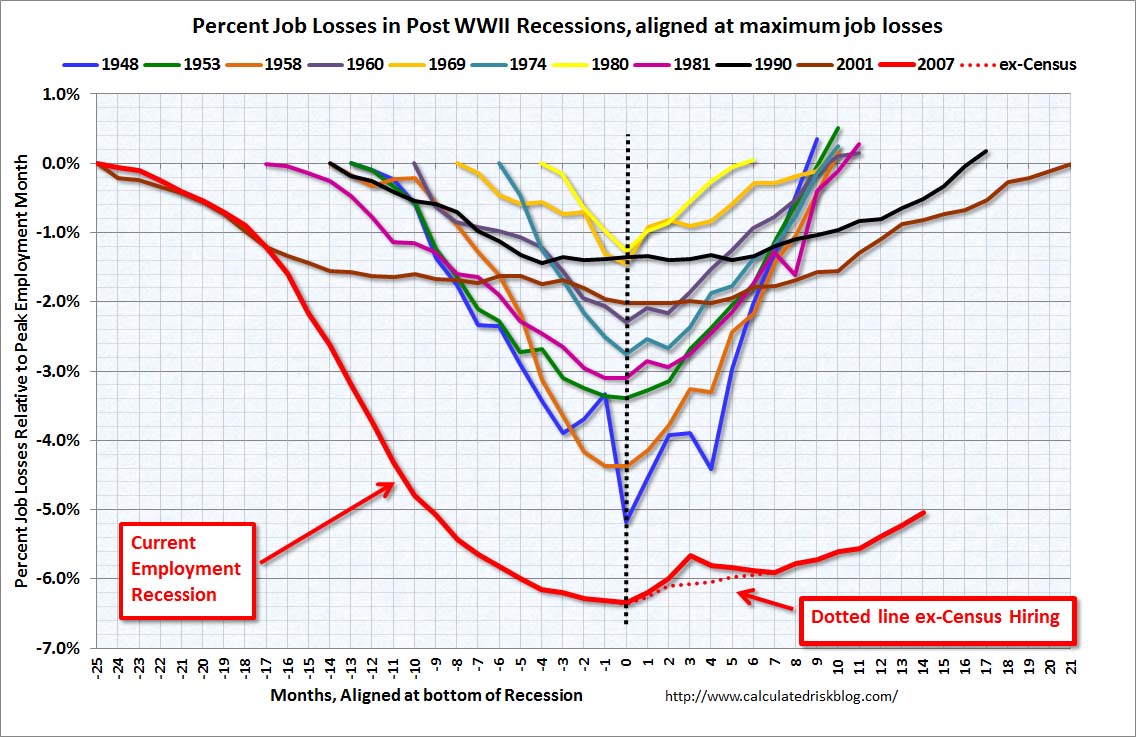

The current employment recession is by far the worst recession since WWII in percentage terms, and 2nd worst in terms of the unemployment rate (only the early '80s recession with a peak of 10.8 percent was worse).
Thursday, May 5, 2011


Wednesday, May 4, 2011
The Dollar's Decline
 THE dollar’s recent decline has taken it to new lows. The chart shows the nominal exchange rate, in trade-weighted terms (ie, against the country’s trading partners). The index is now 30% below its level when the Bretton Woods system was abandoned in the early 1970s and the dollar has halved since 1985, when leading nations adopted the Plaza Accord to drive it lower.
source
Did bin laden Win?

In 2004, Bin Laden released a tape to Al-Jazeera where the former head of Al Qaeda laid out the purpose of the 9/11 attacks, and the organization’s goals. “We are continuing this policy in bleeding America to the point of bankruptcy. Allah willing, and nothing is too great for Allah,” Bin Laden said.

Tuesday, May 3, 2011
The Great Debt Shift
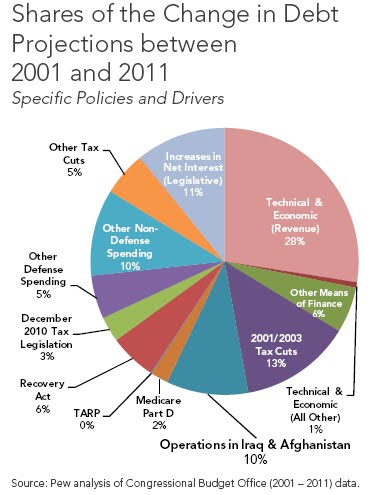

In January 2001, the Congressional Budget Office (CBO) projected under a current law baseline that the federal government would erase its debt in 2006. By 2011, the U.S. government would
be $2.3 trillion in the black.
Monday, May 2, 2011

Subscribe to:
Posts (Atom)