Sunday, September 2, 2007

New Research: Thriving in a Global Economy: The Truth about U.S. Manufacturing and Trade

Executive Summary

Reports of the death of U.S. manufacturing have been greatly exaggerated. Since the depth of the manufacturing recession in 2002, the sector as a whole has experienced robust and sustained output, revenue, and profit growth. The year 2006 was a record year for output, revenues, profits, profit rates, and return on investment in the manufacturing sector. And despite all the stories about the erosion of U.S. manufacturing primacy, the United States remains the world’s most prolific manufacturer—producing two and a half times more output than those vaunted Chinese factories in 2006.

Yet, the rhetoric on Capitol Hill and on the presidential campaign trail about a declining manufacturing sector is reaching a fevered pitch. Policymakers point repeatedly to the loss of 3 million manufacturing jobs as evidence of impending doom, even though those acute losses occurred between 2000 and 2003, and job decline in manufacturing has leveled off to historic averages.

In the first six months of the 110th Congress, more than a dozen antagonistic or protectionist trade-related bills have been introduced, which rely on the presumed precariousness of U.S. manufacturing as justification for the legislation. Justification for those bills is predicated on the belief that manufacturing is in decline and that the failure of U.S. trade policy to address unfair competition is to blame. But those premises are wrong. The totality of evidence points to a robust manufacturing sector that has thrived on account of greater international trade.


from the conclusion:

U.S. manufacturing is generally in superb health, and increasing international trade has a lot to do with that condition. Accordingly, lawmakers should back away from their hostile rhetoric about trade before they adopt policies that will damage the sector. Despite all of the bluster about “saving” U.S. manufacturing, the truth is that the sector is in robust health. Record output, record sales, record profits, record returns on equity, and record compensation define the most recent year’s performance. Rather than being aberrational, one-time blips, those records are all the latest data points of a gradually ascending trend line that has been evident since the beginning of the sector’s recovery.

…The evidence points to a U.S. manufacturing sector that is thriving in a global economy.

read the entire paper here

Imports: Good for the Economy

"U.S. companies spend about $100 billion more on imported inputs ($504 billion) than consumers spend on final goods ($411 billion). This distinction is important because, when most people think about imports, we think about finished, retail consumer goods like Toyotas from Japan, toys or big screen TVs from China, etc., and don't realize that the majority of imports are inputs, raw materials and capital equipment for U.S. firms. Raising trade barriers with protectionist tariffs would create significant harm for U.S. companies and their employees by artificially raising the price of their inputs, putting them at a competitive disadvantage in an increasingly competitive global economy.

Bottom Line: Tariffs on imports are essentially punitive taxes on the inputs of U.S. producers, and if you tax something you'll get less of it, including fewer jobs for Americans working at U.S. companies buying inputs from abroad."


from Carpe Diem

How Different Investments Did Last Week

Friday, August 31, 2007

Self-Interest or Altruism?

There was a bit of confusion in regards to a graphic organizer.

To remedy the problem we will conduct an experiment.


20 bonus points are up for grabs.

Self-interest or altruism?


Self-interest: The individual and the commenter will get 1 point each.
(Maximum 10 points for the individual; 1 point each for commenter)

or

Altruism: The individual receives 2 points per commenter.
(Maximum 20 points for the individual; o points for the anonymous commenters.)


So will altruism or self-interest win?

I will close the thread to comments Monday afternoon. In the event of more than 10 commenters the first group that gets 10 commenters wins.


Reminder when voting if you choice altruism, just type "altruism". Any attempt to identify yourself is not altruism. Self-interest requires a post that includes your name or I will not know who to award the point to.

Self-Interest defeats altruism 3 to 1. Apathy or marginal analysis dominates.

2nd Quarter GDP Growth 3.95%

Another great chart from the Skeptical Optimist

Students: Questions, Comments, Suggestions

So far so good. No major causes for worry.

Parents: Questions, Comments, Suggestions

Another week is about to be completed. Everything seems to running smoothly. Routines are established. It would be a good idea to help me emphasize maturity.

Thursday, August 30, 2007

Top 100 Economics Blogs

from CurrencyTrading.net

"Staying abreast of the world’s economy is vital, whether or not you have hefty investments in the stock market. A close study of economics sheds light on political, social, and even environmental trends, all of which affect even the average person’s daily life... Make at least a couple of them daily or weekly reads to help you become an informed, intelligent, and conscientious citizen." --Laura Milligan

Due to the large number of economics related blogs out there, it is impossible to read them all or even be aware of them all. The basic goal of my blog is to find economics related items of interest that may be helpful to my students (in class or life) from a variety of sources.

Those students who do have some interest in economics beyond simply passing the class should try to read at least a few blogs on a weekly if not daily basis.
"According to Tyler Cowen...that right now blogs are the best place to learn economics."

Reading blogs probably won't increase test scores as much as it will give a person a breadth of knowledge, information, insights, and commentary in economics and the broader field of human action that can't be obtained from from a textbook, classroom or library.

As with any list there will be debate.

I find this list be much better.

Opinions will vary.

If you have found an economics related blog that you enjoy or think might be useful please share.

Corporate Profits

The Commerce Department reported today that corporate profits strengthened in the second quarter, and hit an all-time high of $1.646 trillion on a before tax basis and $1.154 trillion after taxes (see chart above). Profits after taxes grew by 5.4% in the second quarter, after rising by 1.5% in the first quarter. Year over year, corporate profits increased by 3.5%...

Another way to put U.S. corporate profits of $1.646 trillion in perspective is to compare it to world GDP figures. If the $1.646 trillion of profits generated by American businesses were considered to be a "country," the corporate sector of America would be the 8th largest country in the world, just slightly behind Italy, and larger than the entire economies of Canada, Spain, Brazil, Russia, and about twice the size of the entire economies of S. Korea, Mexico, India and Australia!

from Carpe Diem

Tuesday, August 28, 2007

Robert Frank at Google

Robert Frank is a professor of economics at Cornell and author of The Economic Naturalist.

Youtube broadcast

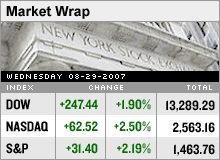
Bad Day for the Dow


The DJIA dropped over 2% today.

Saturday, August 25, 2007

Incentives Matter

Once again thanks for checking out the blog.

Bonus points for the first 5 students to respond.

I need your name, period/block, and your favorite economics website or blog besides mine.


Ooooops. Times up.

Cost -Benefit Analysis: Michael Vick Edition

"Falcons quarterback Michael Vick's guilty plea on federal dogfighting charges could wind up costing him well over $100 million.

Vick will lose $71 million in salary over the next seven years if the Falcons terminate his contract, which legal experts say the team has the right to do.

He also figures to lose as much as $50 million in endorsement income over the next decade, according to an estimate by the University of Oregon's Warsaw Sports Marketing Center.

Then add to Vick's costs the legal fees and other possible fallout from the case."

full story


Friday, August 24, 2007

A Hayekian Hangover

A Hayekian Hangover

What the economy is suffering from is a Hayekian hangover. Friedrich von Hayek and other members of the Austrian School of Economics developed a comprehensive theory of the business cycle early last century. It reached a pinnacle in 1930-31, when Prof. Hayek delivered his famous lectures at the London School of Economics... Accordingly, to comprehend where the economy has been and anticipate its future course, an understanding of Hayek and the Austrians is necessary.

For the Austrians, things go wrong when a central bank sets short-term interest rates too low and allows credit to artificially expand. Interest rates that are too low-lower than those that would be set in a free market-induce businesses to discount the future at artificially low rates. This pumps up the value of long-lived investments and generates an investment-led boom, one that is characterized by too much investment and investment that is biased towards projects that are too long-lived and too capital intensive.

An investment-led boom sows the seeds of its own destruction and is unsustainable, however. Indeed, on the eve of the downturn investors find that the loanable funds for investments are too expensive to justify commitments they made during the preceding monetary expansion. Some businesses engage in distress borrowing, profit margins collapse under the weight of too much costly debt, and-if that is not bad enough-many businesses are saddled with excess capacity, resulting from what turned out to be wrong-headed investment decisions. With that, the investment-driven boom turns into a bust. In short, artificially-created investment booms always end badly...
A Hayekian hangover will vary in its duration and intensity, depending on the degree of the preceding over-investment/malinvestment binge, as well as the state of confidence that accompanies the downturn or hangover phase of the cycle. During this phase, a central bank's attempts to restart the economy by pushing interest rates down will-contrary to orthodox economic doctrine-only delay the required capital restructuring process and prolong the hangover.

If this hangover phase-working off excess capacity and transforming the capital structure to shorten the length of production processes-is not bad enough, the economy is vulnerable during this phase to what Austrians termed a "secondary deflation." If a general feeling of insecurity and pessimism grips individuals and enterprises during a Hayekian hangover, risk aversion and a struggle for liquidity (cash reserves) will ensue. To build liquidity, banks will call in loans and/or not be as willing to extend credit. Not surprisingly, banks are already scrambling for liquidity.

Cartoon: Stock Market Losses