Showing posts with label banking industry. Show all posts

Monday, August 22, 2011

The Fed's Secret Loans

Secret loans from the Fed to Wall Street totaled $1.2 trillion at the height of the 2008 panic.

That’s the conclusion of Bloomberg after analyzing 29,346 pages of documents released by the Fed only because Bloomberg went all the way to the US Supreme Court to obtain them.

The top 10 recipients alone account for 56% of the total. The $669 billion these 10 borrowed is, um, rather larger than the “official bailout figure” of $160 billion represented by the TARP program.


Barry Ritholtz writes:

Imagine if the government and the Federal Reserve were run not by knaves and fools and Wall Street sycophants, but instead, were run honestly for the benefit of the taxpaying voter. Imagine the goal was saving the banking system (not the banks), and the financial rescue was for the benefit of the taxpayers, not the bondholders. Naive thoughts, I totally understand, but hear me out.

A person who truly understood what had happened and why would have considered the following actions. Note these are not ideas come about with the benefit of hindsight, but what a small band of insightful people were saying at the time.

An honest broker of the situation would have:

1. Fire the senior management of the banks (see this)

2. Banned all lobbying activity as a condition of any aid (see this)

3. Forced a Swedish style prepackaged bankruptcy (see this and this)

Instead, we bailed out the bondholders and management, choking off hope for a robust recovery. We are in fact slowly turning Japanese, awaiting the next recession (and the next and the next).

source

Sunday, October 24, 2010

Bank Failures


FDIC Bank Failures by Year
20073
200825
2009140
2010139
Total307

source

Wednesday, September 1, 2010

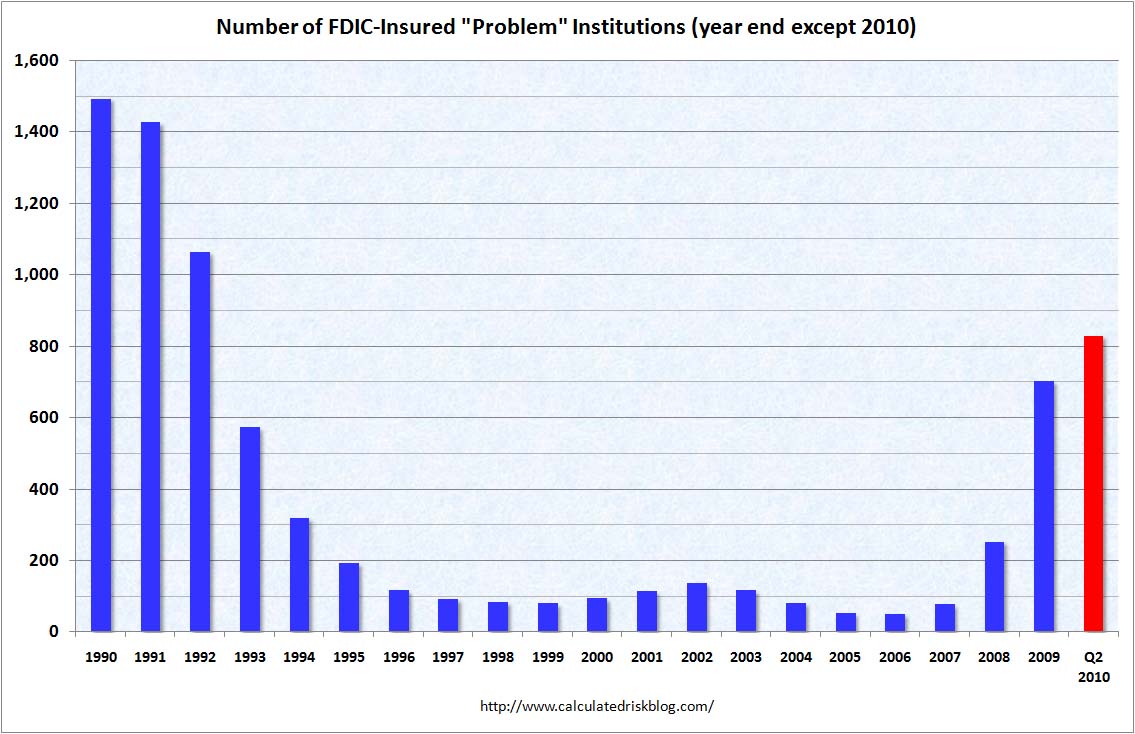
Problem Banks: 829


The FDIC listed 829 banks with $403 billion in assets as “problem” banks in Q2, up from 775 banks in Q1 2010, but the total assets declined from $431 billion in assets in Q1 2010.

There were 702 banks with $403 billion in assets on the list at the end of 2009.

source

Monday, January 25, 2010

Peter Schiff on Banking Reform

Once again, President Obama completely missed the mark on the causes of and solutions to the financial crisis. In his speech this morning, the President outlined a major initiative to increase regulation of banks. He claims the financial crisis was caused by reckless speculation by greedy bankers in search of quick profits. What he fails to acknowledge is that this behavior was the direct result of the cheap credit supplied by the Federal Reserve and the moral hazard supplied by government regulations and subsidies.

In his efforts to prevent the next financial crisis, the President is focused on the symptoms rather than the disease. Therefore, his attempt to prevent future financial crises is doomed to failure, as the misguided policies that led to the last crisis are preserved while even more damaging policies are added. Current Fed policy is more reckless than before; continued subsidies to the mortgage market and the bailouts for banks are creating even bigger moral hazards; and, as a result, the economy is even more leveraged and more vulnerable to rising interest rates than ever.

The only way to prevent another financial crisis would be to reverse the fiscal and monetary policies that lead to the last crisis, and which now threaten to bring on an ever larger one. However, this Administration seems to lack the brains or the guts to do it.

source

Tuesday, September 15, 2009

Jim Rogers on the Economy

Speaking to CNBC Wordwide Exchange today Rogers said "All the government officials and bureaucrats loved the fact Lehman failed, because they could all jump in and support banks."
"This whole problem was not caused by Lehman Brothers or Lehman Brothers failure. Lehman was an effect not a cause."

"The real problem over the past 10-15 years has been that regulators have not let people fail. Had they let people fail we would have solved this problem a long time ago. I don't know why they're not in jail," Rogers said.

Reiterating his view about US monetary policy and their effect on the Dollar, Rogers warned. "I would expect there to be a currency crisis or a semi-crisis this fall or next year. It's crony capitalism, Bernanke and Greenspan have brought crony capitalism to America … but that's not going to solve the world's problems."

"We're going to have zombie capitalism for the next 15-20 years. How long are you going to let the bureaucrats run the thing so we can't have a clean system?," he added.

"Banks have been going bankrupt for a few hundreds years. The way the system works is when somebody fails you let him fail. What we're doing now is we're taking the assets away from the competent people and giving them to incompetent people and telling them now you can compete with competent people with their money."

read the article

Sunday, September 13, 2009

Tyler Cowen on Politics and the Economy

Tyler Cowen's When Politics Don't Belong
FOR years now, many businesses and individuals in the United States have been relying on the power of government, rather than competition in the marketplace, to increase their wealth. This is politicization of the economy. It made the financial crisis much worse, and the trend is accelerating...

But we are now injecting politics ever more deeply into the American economy, whether it be in finance or in sectors like health care. Not only have we failed to learn from our mistakes, but also we’re repeating them on an ever-larger scale.

Lately the surviving major banks have reported brisk profits, yet in large part this reflects astute politicking and lobbying rather than commercial skill...

President Dwight D. Eisenhower warned of the birth of a military-industrial complex. Today we have a financial-regulatory complex, and it has meant a consolidation of power and privilege.

We’ve created a class of politically protected “too big to fail” institutions, and the current proposals for regulatory reform further cement this notion. Even more worrying, with so many explicit and implicit financial guarantees, we are courting a bigger financial crisis the next time something major goes wrong.

We should stop using political favors as a means of managing an economic sector...

read the entire essay

Barry Ritholtz comments on Cowen's essay

The large banks and brokers lobbied for special treatment and got it; they manipulated government legislation for their own ends; They asked for and received special treatment. This is a unique dispensation that almost no other businesses have enjoyed — certainly nowhere near the degree the finance sectors has received. Instead of earning their way via market place competition, these financials were uniquely treated in terms of regulation, legislation and tax policy.

Indeed, many people still seem wed to the wrong belief — it was not too much regulation that caused the problems. Rather, it was the special exemptions from regulation that in reality led to the crisis. From leverage to derivatives to lending standards to interest rates, the government acquiesced to the wants of the banking sector.

source

My thoughts: Ritholtz likes to talk of "radical deregulation." This is not what we have. Deregulation would apply across the board to all players. Ritholtz correctly points out that "these financials were uniquely treated in terms of regulation, legislation and tax policy." This is exactly what Cowen point out when he states, "Today we have a financial-regulatory complex, and it has meant a consolidation of power and privilege." This disagreement is more about terminology that facts.

Wednesday, March 25, 2009

Geithner's Toxic Asset Plan


source

My thoughts: No knows the values of the toxic assets. The $100 pool is at best a guess.